Sewer line problems: signs, causes and repair options
Short answer
When several drains back up or gurgle at once, the problem is usually in the main sewer line rather than a single drain. Common causes are tree roots, grease buildup, sagging pipe and aging cast iron or clay. A sewer camera inspection shows the cause before you choose between cleaning, spot repair or replacement.
In this guide
Every drain in your home flows into one main sewer line that carries waste to the city sewer or a septic tank. When that line has a problem, it shows up in more than one place.
The key question is whether you have a clog in one fixture or a problem in the main line.
Signs the problem is in the main sewer line
- Several fixtures drain slowly or back up at the same time.
- Water comes up in the shower or tub when the toilet flushes.
- Toilets gurgle when a sink or washing machine drains.
- Sewage or dirty water appears at a basement floor drain.
- Sewer odor inside or in the yard, or soggy, unusually green patches of lawn over the line.
Common causes
Tree roots
Roots find their way into joints and cracks, then grow into a mat that catches waste. Older clay and cast iron lines are most vulnerable.
Grease and wipes
Cooking grease hardens in the line, and so-called flushable wipes do not break down like toilet paper. Together they form stubborn blockages.
Sagging pipe
If soil settles, a section of pipe can sink and form a low spot, called a belly, where waste collects.
Aging materials
Cast iron corrodes from the inside, clay joints separate, and Orangeburg pipe, a fiber pipe used in some mid-century homes, can deform and collapse.
If sewage is backing up into the house, stop using water until the line is cleared. Sewage carries bacteria, so wear gloves and keep children and pets away from the area.
How the problem is diagnosed
A plumber usually starts by clearing the line through the cleanout, then runs a camera through the pipe. The video shows roots, breaks, bellies and the pipe material, and a locator can mark the problem spot on the ground. Ask to see the footage.
Repair options
| Option | When it fits |
|---|---|
| Snaking or hydro jetting | Clogs, grease and roots in a line that is otherwise sound |
| Spot repair | One broken or sagging section |
| Pipe lining (trenchless) | Cracked or leaking pipe that still holds its shape |
| Pipe bursting (trenchless) | Pipe that needs full replacement, with access pits at each end |
| Excavation and replacement | Collapsed pipe, severe sags or where trenchless is not possible |
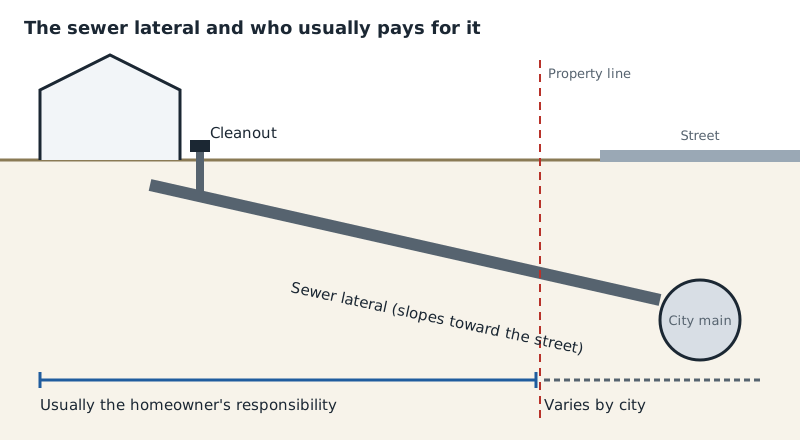
Who pays for the sewer line
In most U.S. cities, the homeowner is responsible for the sewer lateral from the house to the city main or to the property line, but the rules vary. Check with your city public works department before work starts.
Common questions
How do I know if it is a clog or a sewer line problem?
One slow drain is usually a local clog. Several fixtures backing up or gurgling together point to the main sewer line.
Does homeowners insurance cover sewer line repair?
Standard policies often exclude sewer line repair and sewer backups unless you add specific coverage. Check your policy and ask your insurer.
Was this article helpful?
Sorry about that. What was missing?
Please do not include personal information. Links are not accepted.
Thanks for your feedback. It helps us improve our guides.