Water heater connections explained: flex lines, nipples and unions
Short answer
A water heater connects to the house through hot and cold water lines, usually with flexible connectors, and often dielectric nipples or unions that prevent corrosion where copper meets the steel tank. Gas heaters also have a gas connector, a shutoff valve and a sediment trap. Leaks at these connections are common and usually easy to fix.
In this guide
The top of a water heater can look like a tangle of pipes and fittings. Each piece has a job, and knowing them helps you spot leaks and understand a plumber's quote.
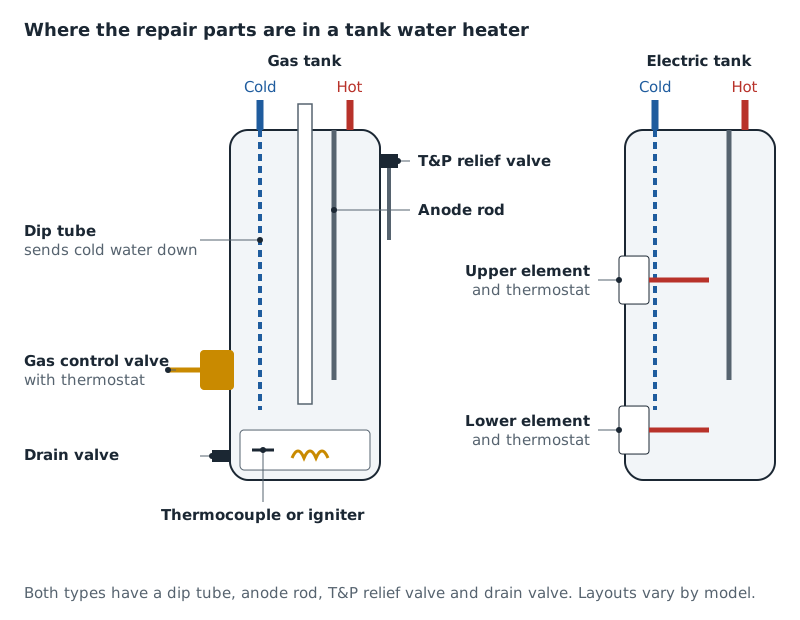
Water connections
| Part | What it does |
|---|---|
| Cold inlet and hot outlet | Bring cold water in and send hot water out |
| Flexible water connectors | Make installation easier and absorb movement |
| Dielectric nipples or unions | Separate copper from the steel tank to limit galvanic corrosion |
| Heat trap nipples | Reduce heat loss up the pipes when water is not flowing |
| Cold water shutoff valve | Isolates the heater for service |
Gas connections
- Manual gas shutoff valve near the heater.
- Sediment trap (drip leg), a short capped pipe that catches debris before it reaches the gas valve. Codes generally require one.
- Gas connector, which must be an approved appliance connector sized for the heater. Old connectors should not be reused.
If you smell gas, do not touch switches or light anything. Leave the house and call your gas utility from outside.
Common connection problems
- Corroded fittings with green or white crust, often where dissimilar metals meet
- Drips from worn flex connector washers
- Kinked connectors that reduce flow
- A cold water valve that leaks at the stem or will not close
Small drips at fittings are usually simple repairs. A leak from the tank itself is not; see our water heater leaking repair cost guide.
Signs a connection needs attention
| What you see | What it usually means |
|---|---|
| Green or white crust on fittings | Slow leak and corrosion |
| Rust streaks down the tank jacket | Leak at a top fitting or corroded nipple |
| Drips from the flex line nut | Worn washer or loose nut |
| Hissing or gas smell at the gas connector | Possible gas leak: leave and call |
Connections are also a common upgrade point during a replacement: plumbers often add new shutoffs, dielectric fittings, an expansion tank and a drain pan. See our water heater replacement cost guide.
Common questions
Why are there dielectric fittings on a water heater?
They separate copper pipes from the steel tank to reduce galvanic corrosion at the connection.
Can I reuse the gas connector when replacing a water heater?
It is best practice, and often required, to install a new approved connector.
Was this article helpful?
Sorry about that. What was missing?
Please do not include personal information. Links are not accepted.
Thanks for your feedback. It helps us improve our guides.
More in Water heaters
- Water heater problems: a homeowner's guide (start here)
- Water heater leaking from the bottom: causes and what to do
- How to replace a water heater thermocouple
- Water heater drain pan: is it required
- Hot water not working but cold water is: causes
- Water heater leaking from the relief valve pipe
- How old is my Bradford White water heater? Reading the serial number
- How old is my A. O. Smith water heater? Reading the serial number
- How old is my Rheem water heater? Reading the serial number