Water heater leaking from the bottom: causes and what to do
Short answer
A leak at the bottom of a water heater is usually the drain valve, the temperature and pressure relief valve draining down the tube, condensation, or water running down from a fitting above. If water is coming from the tank itself, the tank has corroded through and needs to be replaced.
In this guide
Finding water under your water heater is stressful, but it does not always mean the tank is done. Several parts sit at or near the bottom of the unit, and some leaks start higher up and simply collect there.
The steps below help you find the source before you decide on a repair or a replacement.
Before you start: turn off the power at the breaker for an electric heater, or turn the gas control to the pilot or off position for a gas heater. Water in the tank can be hot enough to scald.
First, stop more water from leaking
- Turn off the power or gas as described above.
- Close the cold water shutoff valve on the pipe entering the top of the heater.
- Dry the area with towels so you can see where fresh water appears.
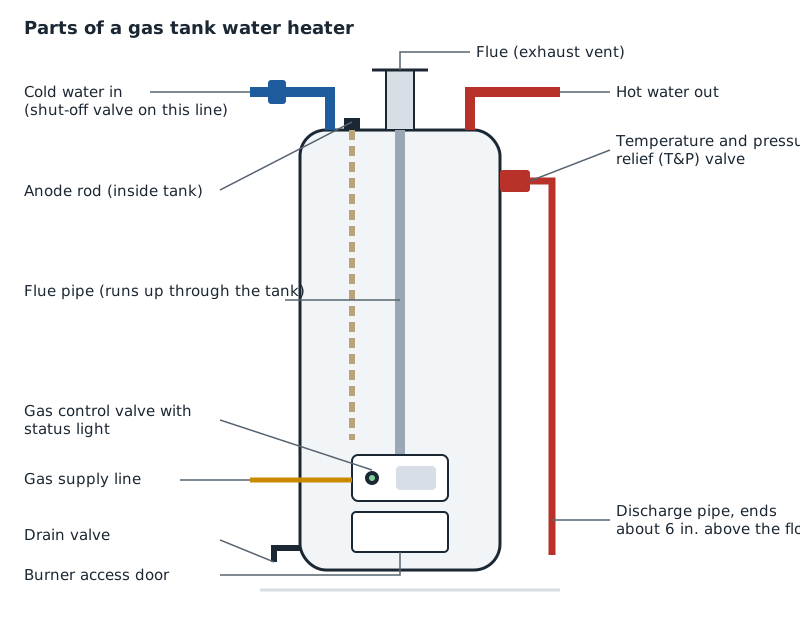
The five common causes
| Cause | What you see | Fixable? |
|---|---|---|
| Drain valve | Drip from the valve near the bottom of the tank | Yes, tighten or replace |
| Relief valve (T&P) | Water from the pipe running down the side | Yes, but find out why it opened |
| Condensation | Small puddle, mostly when the burner runs on cold days | Usually no repair needed |
| Leak from above | Water tracks down the jacket from pipes or fittings | Yes, repair the fitting |
| Tank corrosion | Water seeping from under the jacket or the base | No, replace the heater |
Drain valve leaks
The drain valve is the spigot near the bottom of the tank. Plastic valves on newer heaters often drip after a flush because sediment keeps them from sealing. Try closing it firmly by hand. If it still drips, a hose cap is a short-term fix, and replacing the valve with a brass one is a permanent one.
Relief valve discharge
The temperature and pressure relief valve opens when the tank gets too hot or the pressure climbs too high. Its discharge pipe ends a few inches above the floor, so a puddle here can look like a bottom leak. A valve that opens repeatedly usually means the thermostat is set too high or the house has high water pressure or no working expansion tank.
Do not cap or plug the relief valve pipe. The valve is a safety device that keeps the tank from over-pressurizing.
Condensation on gas heaters
When the tank fills with very cold water, moisture in the burner exhaust condenses on the cold tank and drips onto the burner area. It is most common in winter and after heavy hot water use. It should stop once the tank is fully heated.
When the tank itself is leaking
Water tanks are steel with a glass lining. Over time the lining cracks and the steel rusts through, usually from the inside out. Once that happens there is no reliable repair. Plan to replace the heater soon, and keep the water and power off until then if the leak is steady.
Common questions
Can I still use a water heater that is leaking from the bottom?
If the leak is from the drain valve or condensation, yes, once the cause is handled. If the tank itself is leaking, turn off the water and power and replace it, because the leak will only get worse.
How much does it cost to fix a leaking water heater?
A new drain valve or relief valve is an inexpensive part and a short job for a plumber. A leaking tank means replacing the whole heater.
Is a leaking water heater dangerous?
A slow leak mainly risks water damage. A relief valve that keeps opening is a warning sign of too much heat or pressure and should be checked promptly.
Was this article helpful?
Sorry about that. What was missing?
Please do not include personal information. Links are not accepted.
Thanks for your feedback. It helps us improve our guides.
More in Water heaters
- Water heater problems: a homeowner's guide (start here)
- How old is my Bradford White water heater? Reading the serial number
- How old is my A. O. Smith water heater? Reading the serial number
- How old is my Rheem water heater? Reading the serial number
- Water heater leaking from the top: causes and fixes
- Water heater making popping noises: causes and fixes
- Hot water smells like rotten eggs: causes and fixes
- How to flush a water heater
- Water heater not heating: how to find the problem