Water heater leaking from the top: causes and fixes
Short answer
Leaks at the top of a water heater usually come from the cold or hot water connections, corroded pipe nipples, the temperature and pressure relief valve threads, or the anode rod port. Most of these can be repaired without replacing the heater.
In this guide
A leak at the top of a water heater is usually better news than a water heater leaking from the bottom. The top holds the pipe connections, valves and fittings, and most of those can be repaired or replaced.
Finding the exact spot is the hard part, because water runs down the tank and can show up somewhere else.
Before you start: turn off the power for an electric heater or set the gas control to pilot, and close the cold water supply valve. The pipes at the top can be hot.
How to find the leak
- Dry the top of the tank and all the fittings with a towel.
- Lay a dry paper towel on the top of the tank and wrap tissue around each fitting.
- Open the cold water supply and watch which spot gets wet first.
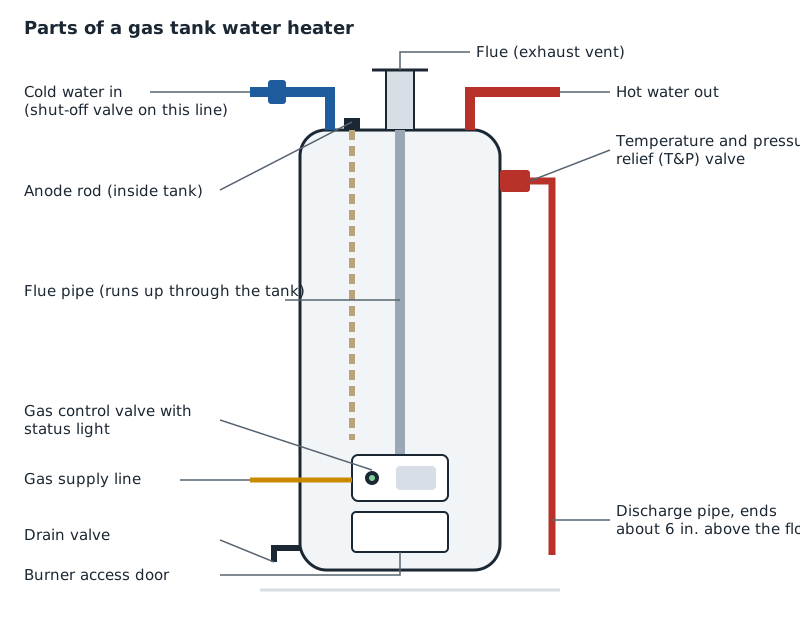
Common sources of a leak at the top
Cold inlet and hot outlet connections
Flexible water connectors can loosen or wear out, and their rubber washers can harden with age. Tighten the connection slightly with a wrench. If it still drips, replace the connector.
Corroded pipe nipples
The short threaded pipes that screw into the tank, often dielectric or heat trap nipples, can corrode where two different metals meet. Rust and crusty buildup around them is the giveaway. Replacing them is a common plumber repair.
Relief valve threads or the valve itself
Water around the base of the temperature and pressure relief valve points to its threads. Water coming out of its discharge pipe is different: the valve is opening, either because it is worn or because the heat or pressure is too high.
Anode rod port
The anode rod screws into a port on top of the tank, sometimes under a plastic cap. If the threads corrode, water can seep out. Resealing or replacing the anode fixes it.
Condensation on cold pipes
In humid weather, the cold water line can sweat and drip onto the tank. If the "leak" disappears when the air is dry, insulate the cold pipe.
When a top leak means replacement
If water is seeping from the tank seams or from under the top cover with no fitting involved, the tank itself may be leaking. That cannot be repaired. A heater near the end of its expected life is also a good candidate for replacement rather than new fittings.
Common questions
Is a water heater leaking from the top an emergency?
A slow drip is not usually an emergency, but it can damage the tank and floor over time. Close the cold supply if the leak is steady, and fix it soon.
Can I tighten the pipes on top of my water heater myself?
Snugging a connection a quarter turn is a reasonable first step. Replacing corroded nipples or the relief valve involves draining the tank and is a job many people hand to a plumber.
Was this article helpful?
Sorry about that. What was missing?
Please do not include personal information. Links are not accepted.
Thanks for your feedback. It helps us improve our guides.
More in Water heaters
- Water heater problems: a homeowner's guide (start here)
- Water heater leaking from the bottom: causes and what to do
- How old is my Bradford White water heater? Reading the serial number
- How old is my A. O. Smith water heater? Reading the serial number
- How old is my Rheem water heater? Reading the serial number
- Water heater making popping noises: causes and fixes
- Hot water smells like rotten eggs: causes and fixes
- How to flush a water heater
- Water heater not heating: how to find the problem