How to winterize outdoor faucets (hose bibs)
Short answer
To winterize an outdoor faucet, disconnect the hose, close the indoor shutoff valve that feeds the faucet, open the outdoor faucet to drain the line, and leave it open for the winter. Frost-free faucets drain themselves only when the hose is removed. An insulated faucet cover adds protection in very cold areas.
Outdoor faucets, also called hose bibs or spigots, are among the most common places for pipes to freeze. The pipe runs through the wall right next to cold outside air, and a burst there often goes unnoticed until water pours into a basement or wall.
Standard or frost-free?
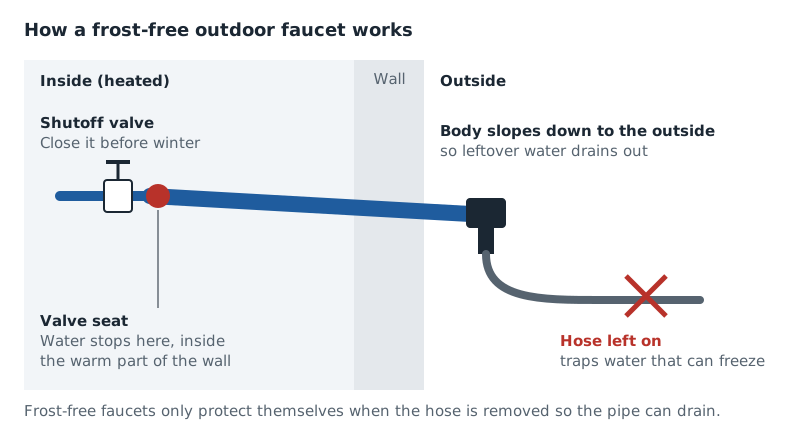
A standard outdoor faucet stops the water right at the spout, outside the wall, so the pipe behind it stays full and can freeze. A frost-free faucet has a long body, and its valve closes inside the heated part of the wall. The pipe between the valve and the spout drains when you turn it off, as long as nothing blocks it.
Many frost-free faucets have a longer body than a standard one and a handle that turns on a long stem. If you are not sure which you have, treat it as a standard faucet and winterize it fully.
Step by step
- Disconnect the hose. Drain it and store it. A connected hose traps water in a frost-free faucet and defeats its design.
- Find the indoor shutoff. Look inside the house, usually in the basement or crawl space, on the pipe that leads to the outdoor faucet.
- Close the shutoff valve. Some have a small drain cap; if yours does, place a bucket underneath.
- Open the outdoor faucet to let the water drain out of the line. If the indoor valve has a drain cap, open it too to let air in so the line empties.
- Leave the outdoor faucet open for the winter so any remaining water has room to expand.
An insulated foam faucet cover is inexpensive and adds protection, especially for standard faucets or homes in very cold climates. It works best on a faucet that is already shut off and drained.
If there is no indoor shutoff
Some homes, especially in mild climates, have no separate shutoff for outdoor faucets. In that case, disconnect the hose, use an insulated cover and consider having a plumber add a shutoff valve or replace the faucet with a frost-free model.
In spring
- Close the outdoor faucet.
- Open the indoor shutoff slowly.
- Check the faucet and the wall behind it for leaks when you first run water.
A frozen and split pipe inside a frost-free faucet may only leak when the faucet is turned on and a hose is attached, so check inside the house after the first use. If you find a leak, see our burst pipe repair cost guide for what the fix usually costs.
Common questions
Do frost-free faucets need to be winterized?
They still need the hose removed so they can drain. Closing an indoor shutoff adds protection in very cold climates.
Should I leave outdoor faucets open in winter?
Yes, after the indoor shutoff is closed and the line is drained. An open faucet gives trapped water room to expand.
Do outdoor faucet covers work?
They help, especially combined with shutting off and draining the line, but a cover alone may not protect a full pipe in a hard freeze.
Was this article helpful?
Sorry about that. What was missing?
Please do not include personal information. Links are not accepted.
Thanks for your feedback. It helps us improve our guides.
More in Maintenance
- Home plumbing maintenance checklist: what to do each season (start here)
- Water softener maintenance: salt, cleaning and resin care
- Septic tank maintenance: pumping, inspections and daily habits
- How to check and replace a water heater anode rod
- Noritz tankless water heater maintenance: a yearly checklist
- Navien tankless water heater maintenance: a yearly checklist
- Rinnai tankless water heater maintenance: a yearly checklist
- Sump pump winter maintenance
- Tankless water heater freeze protection: how it works and how to drain one