Water heater element replacement cost
Short answer
Replacing an electric water heater heating element typically costs about $100 to $350 with a plumber or electrician in 2026, according to HomeGuide. The element itself is inexpensive. Many technicians test and replace both elements and thermostats on one visit, which raises the bill but avoids a second service call.
In this guide
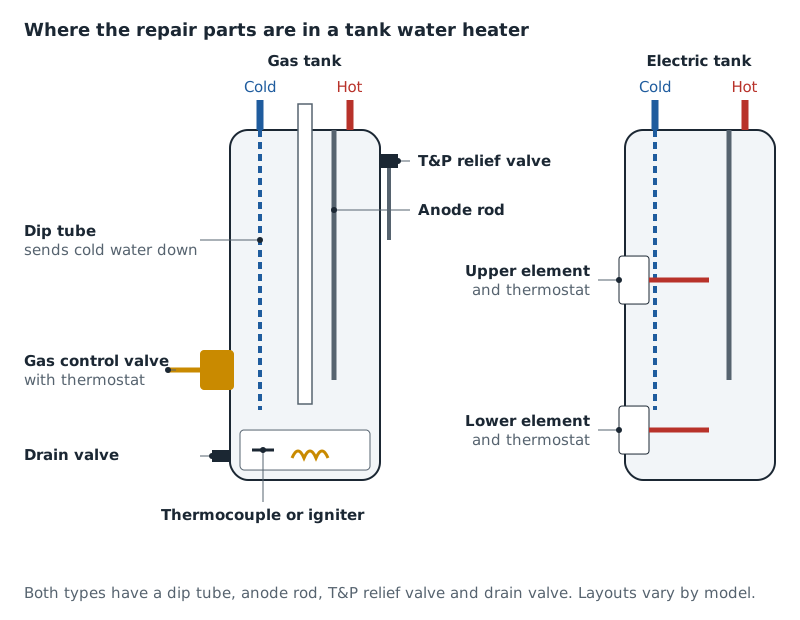
Most electric tank water heaters have two heating elements, one near the top and one near the bottom. When one fails, you get lukewarm water or hot water that runs out quickly. When the upper one fails, you often get none.
Figures are 2026 national estimates compiled from published cost guides such as HomeGuide, Angi and HomeAdvisor. Labor rates in high-cost metro areas often run above these ranges.
Typical costs
| Job | Typical 2026 cost |
|---|---|
| One element, replaced by a pro | About $100 to $350 |
| Element and thermostat on the same visit | Toward the upper end of that range or a little above |
| Service call if diagnosed only | About $50 to $200 |
Signs an element has failed
- Hot water runs out much faster than it used to: often the lower element.
- No hot water at all: often the upper element or its thermostat.
- The breaker trips when the heater turns on: an element may have shorted.
- The high-limit reset button trips repeatedly.
A technician confirms it with a multimeter, checking the element's resistance and whether it is shorted to the tank.
Turn off the power at the breaker before opening an electric water heater's access panels. The elements and thermostats carry 240 volts.
What affects the price
- Element style. Screw-in elements are the most common; older bolt-in types need a matching part.
- Draining the tank. Replacing an element means draining the tank below it, which adds time.
- Scale. Heavily scaled elements and sediment slow the job and point to maintenance the tank has missed.
- A second part. Thermostats often fail alongside elements.
DIY or pro?
Replacing an element is a common DIY repair for people comfortable with electrical work: turn off the breaker, confirm the power is off with a tester, drain the tank, and use an element wrench. If you are not sure, hire a pro; mistakes with 240-volt circuits are dangerous, and an element powered on in an empty tank burns out immediately.
Prevent the next failure
Sediment and scale shorten element life. Flushing the tank yearly helps; see our water heater maintenance cost guide.
Not sure how old your heater is? The serial number tells you. See our guides for Rheem, A. O. Smith and Bradford White, and use our repair or replace water heater calculator to see how age changes the math.
Upper or lower element?
| Symptom | Usual suspect |
|---|---|
| No hot water at all | Upper element or upper thermostat |
| Hot water runs out quickly | Lower element or lower thermostat |
| Water only lukewarm | Either element, or thermostats set too low |
| Breaker trips when heating starts | An element shorted to the tank |
How a technician tests it
- Turns off the breaker and confirms the power is off at the terminals.
- Disconnects one element wire and measures resistance across the element. A reading far outside the expected range means it has failed.
- Checks for continuity between each terminal and the tank. Any reading means the element is shorted.
- Checks the thermostats and the high-limit reset at the same time.
Match the replacement
The new element must match the voltage and wattage printed on the heater's rating label, commonly 240 volts and 3,500 to 5,500 watts on residential tanks. A mismatched element can overheat wiring or heat poorly.
Is it worth fixing?
On a tank under about ten years old without leaks, an element is almost always worth replacing. If the tank is older, compare the repair with a new heater; our repair or replace water heater calculator helps with that math.
Getting a fair price
- Ask for a flat price that includes the part, labor and the service call.
- Ask the technician to show you the reading or the failed part that proves the diagnosis.
- Check the heater's age from the serial number. A repair on a heater past about ten years deserves a second look.
- Check the warranty first. Parts are often covered longer than labor.
Common questions
How long do water heater elements last?
It varies with water hardness and maintenance. Sediment and scale are the main reasons elements fail early.
Should both elements be replaced at once?
Not necessarily. Test both. If one has failed and the heater is older, replacing both on the same visit can save a second service call.
Was this article helpful?
Sorry about that. What was missing?
Please do not include personal information. Links are not accepted.
Thanks for your feedback. It helps us improve our guides.
More in Plumbing costs
- Plumbing costs: what drives the price of a repair (start here)
- Water heater anode rod replacement cost (2026)
- Gas line installation cost (2026)
- Water heater expansion tank installation cost (2026)
- Water softener installation cost (2026)
- Well pump replacement cost (2026)
- Sump pump repair cost (2026)
- Water heater maintenance cost: tank and tankless (2026)
- Tankless water heater repair cost (2026)